Showing posts with label Mick Ronson. Show all posts

Saturday, November 09, 2013

Perfect Day

Lou Reed & Laurie Anderson, earlier this year.
A former co-worker once said that the three things that sell books, music and movies in America are sex, death and anger. I've yet to see him proved wrong.

In light of the recent passing of Lou Reed, I've been seeing quite a lot of well deserved tributes and accolades being thrown his way, the best of these being the heartfelt note written by his wife, Laurie Anderson. Nonetheless, and I hate to say this, but so many of these acknowledgements have come off as somewhat contrived.

Now, I both understand and welcome those who may be late to the party, but grow to appreciate the work of any artist or musician long after the fact because, for instance, they weren't yet alive at the time of the music's release, or were just too young for it. That's not only completely fine, but also accounts for most of us. But if something like that is the case for you, then please don't pretend that you've been a hardcore lifelong fan all along. That rings false and smacks of status-seeking hipsterism. Even the few serious Lou fans I've known that owned a copy of Reed's notoriously abrasive "Metal Machine Music" album could not honestly say they endured a continuous front-to-back listen, and even they weren't ever going on about how profoundly Lou's music had impacted their life. So when I hear things like that, it sounds disingenuous at the least. If all the people who are now saying how Lou's music meant so much to them had been buying his records all along, then both Lou and his legacy would have been much better off.

I also find it interesting that according to the online media data tracked by the analytics company, Musicmetric, Reed jumped from adding around 1,500 Facebook fans this year to adding a whopping 37,864 just on the Monday following his departure! What newcomers now expect from his Facebook page is not clear.

In the early 1970's, I was in junior high and already heavily into the music of the day, although neither myself or my friends had yet paid much notice to Reed's work in The Velvet Underground. I can tell you with certainty that if we had heard them at that time, all of us would have hated their music. The Velvets would prove to be an acquired taste. In fact, it wasn't until decades later that we all figured out that without The Velvet Underground, the Indie Rock explosion of the 90's would never have been possible.

Like many others, our first dose of Lou came later in the form of "Walk On The Wild Side", the first single from his 1972 album "Transformer". It was one of those songs that became a hit almost in spite of itself. While the song had a unique and hypnotic sound, the lyrics were far beyond what even progressive FM radio was willing to promote, despite the worldwide success of The Kinks' tale of transvestism, "Lola", from 2 years earlier. A heavily edited version finally took hold at radio. But "Walk On The Wild Side" wasn't the only thing the album had going for it. Not by a long shot.

Mick Ronson and Lou Reed, 1972
By 1972, the world had seemingly gone mad for David Bowie and all things even distantly related to him. Bowie had often cited both Reed and The Velvet Underground as profound influences. Given that the two were on the same record label, RCA, it was inevitable that they would work together. Indeed, "Transformer" was produced by both David Bowie and Bowie's guitarist and arranger, Mick Ronson. Bowie had referenced The Velvet Underground in the cover notes for his album "Hunky Dory" and regularly performed the VU songs "White Light/White Heat" and "I'm Waiting For The Man" at his concerts. Bowie even began recording "White Light/White Heat" for inclusion on his covers album, "Pin-Ups", but it was never completed. Ronson ended up using the backing track and finishing the recording for his solo album, "Play Don't Worry", in 1974. Although Bowie's attachment to the project was the draw, Ronson played the major role in the recording of "Transformer", serving as the co-producer and primary session musician, contributing guitar, piano, recorder and backing vocals, and notably contributing the lush string arrangement for the favorite Lou Reed song of many, "Perfect Day".


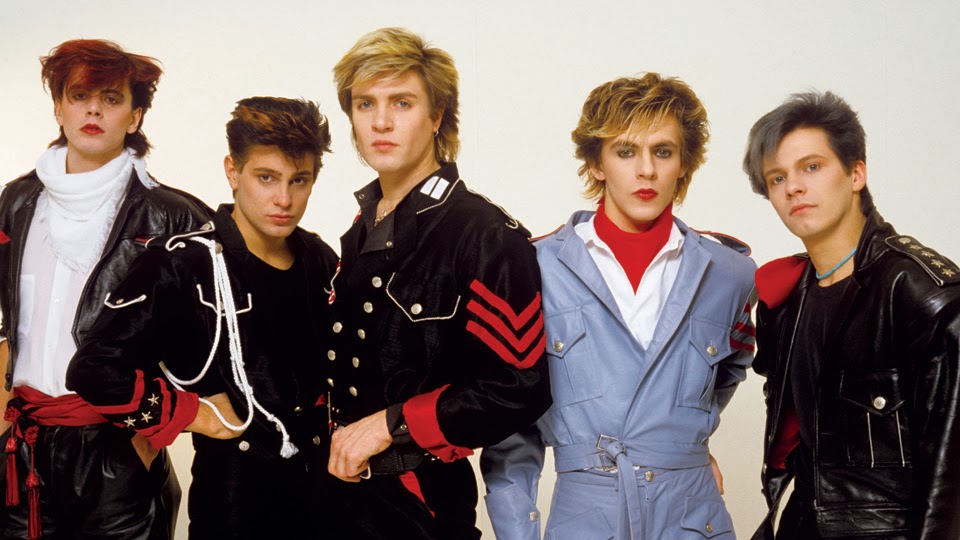
The lovely & talented Duran Duran, in the early 80's.
Fast forward to the mid-1980's. Technology had taken great leaps and a sharply digital edge began to dominate the production sounds of the Pop charts. The resurgence of Dance music was a cyclical dismissal of the simplistic lessons of late 70's Punk, and another enormous wave of British bands had overtaken the world's airwaves, record stores and televisions. Chief among these was Duran Duran, named after the villain from Roger Vadim's French science-fiction film, "Barbarella", Dr. Durand Durand. The band was easily one of the most successful of the 1980's, largely due to their heavy rotation in the MTV-driven video revolution. Since then, they have placed 14 singles in the Top 10 of the UK Singles Chart, and 21 in the Billboard Hot 100, achieving sales of over 100 million records.

The cover art for "Thank You".
In 1995, the band released their inevitable cover album, entitled "Thank You", which included their version of Lou Reed's "Perfect Day". In a video interview provided with the album's press kit, Reed himself said he considered Duran Duran's recording to be the best cover ever done of one of his songs. Whether Lou was sincere or just being kind and/or grateful, I don't know, but the Duransters certainly acquitted themselves well enough. At least on this track they did. Most album length cover projects should have been 5-7 song EP's, and this is one of those. Often, albums like this are simply too much of a good thing, which is far better than an overdose of one bad idea after another.

Here's Duran2 with Lou Reed's "Perfect Day". We hope you somehow manage to have one of your own.


Surprisingly, the entire album catalog of Duran Duran remains in print. This catalog includes several different attempts at a definitive collection, of which only one succeeds, and it is both worthy and capable of plugging the Duran-a-rama vacancy in your music library.

I'm certain there's been a bit of a run on albums from Lou Reed and The Velvet Underground as of late, but that is certainly not any indication or inference that those recordings are going out of print and are never to return. Quite the contrary. That is an urban myth the record companies want you to believe so the post-mortem buying frenzy will continue. You longtime Velvet fans probably have everything already, but for our newer or more casual listeners, I will recommend the so-called "banana album", or this excellent 2 disc anthology.

Lou Reed himself, however, is one of those rare performers whose work has not been well served by 'best-of' collections. So, while "Transformer" is a very good document of the glittery early 70's, as is the fabled live album, "Rock & Roll Animal", my recommendation for a definitive Lou Reed album is the gritty 1989 masterwork, "New York". In the opinion of many, Lou was never better than on this one, and I concur.

Saturday, May 18, 2013

All The Young Dudes

For Mott The Hoople, it really was all about the shoes.
Mott The Hoople's recording of the David Bowie song, "All The Young Dudes" usually pops up on most any decent compilation of '70's rock. The song has a distinct tie to the early part of the decade, when British Glam ran amok through the high schools of America, despite the best attempts at taming kids with the likes of The Carpenters, The Captain & Tennille, America and ironically, Elton John, along with some of the other more saccharine pop idol singles that dominated radio airplay. In retrospect, Glam was just the warmup for the Punk explosion in '77. Even though the band members of Mott were all straight, this song became a gay anthem, at least in America, thanks to lyrics like "Lucy looks sweet 'cause he dresses like a queen".

Mott had very nearly packed it in by 1971 after releasing 4 albums, yet still had a cult following in England and Bowie was a big fan. Bowie heard about their impending breakup when Mott bass player Pete 'Overend' Watts called him up, looking for work. In an effort to keep the band together, he offered to produce their next album and provide them with a song he was working on. Since they had alienated their record label, Island, Bowie got them some time at Olympic Studios in London in the middle of the night. Besides producing the track, Bowie played some guitar, did handclaps and sang backup.


Yep, it was one of those 'game changer' albums.
When Bowie first offered the song to Mott The Hoople, they recognized its potential straight away.  Mott didn't know this when they recorded it, but Bowie had intended it for his own album, "The Rise and Fall of Ziggy Stardust and the Spiders From Mars". Good thing they accepted it, since Mott had already rejected Bowie’s “Suffragette City”, which would become an essential track on "Ziggy Stardust".

The lyric line, "All the young dudes carry the news" refers to part of Bowie's story where there is no electricity, and Ziggy Stardust uses songs to spread the news. Said Bowie: "'All the Young Dudes' is a song about this news. It's not a hymn to the youth, as people thought. It is completely the opposite".

David Bowie and Mick Ronson, 1972
Another lyric, "Wendy's stealing clothes from unlocked cars" was originally sung as "Wendy's stealing clothes from Marks and Sparks", which was the popular nickname for the British department store Marks & Spencer. The BBC refused to play a song if they thought it contained lyrics advertising a product. In their hit, "Lola", The Kinks had to change "Just like Coca-Cola" to "Just like cherry cola" at the last minute, so Mott had to get rid of Marks and Sparks. At the insistence of their record company, Ian Hunter flew from New York to London to re-record the line as "unlocked cars" before heading right back to America. Such is how things were done before we had transatlantic fiber optic data lines.

After the first recording session for this song, Bowie reportedly thought it was lagging at the end (which may provide a clue as to why he donated the song). Mott's lead singer Ian Hunter responded with the idea for the one-way conversation, which begins with him saying, "Hey, you down there, you with the glasses!" Said Hunter: "I remembered an encounter I'd had with a heckler during a recent gig at the Rainbow in London. He was annoying me and I ended up pouring beer all over him."

The song became the title track for what became Mott's breakthrough album for their new record company, Columbia. They followed up with "Mott" in 1973, and of course, "The Hoople" the following year.

Because I'm sure some of you are curious, the band's name came from the 1966 Willard Manus novel, "Mott the Hoople", about an eccentric who works in a circus freak show. According to a 1966 review of the novel, "Hooples, to clear this up right at the beginning, 'make the whole game possible, Christmas Clubs especially, politics, advertising agencies, pay toilets, even popes and mystery novels.' Obviously they're squares and Mott, Norman Mott, is certainly not." Sounds like band name fodder to me!

Despite having donated such a great song, Bowie had several bullets in reserve for the Ziggy project, so it wasn't any sort of great loss. Some of the songs besides "Dudes" that didn't make the final running order for one reason or another include "John, I'm Only Dancing" and "Velvet Goldmine", both released later as single b-sides and "Man In The Middle", which has never been officially released. But Bowie had also recorded his own take on "All The Young Dudes" during the sessions for Ziggy. Once Mott had a hit with it, Bowie shelved his version of the song, which sat unreleased until EMI put out a Bowie compilation in 1995. I'd only heard this recording once prior to the 90's, on a late 70's radio broadcast of rare Bowie stuff. The mix was very rough and distorted, like most bootlegs. It sure is great to have it available properly mixed and mastered.

Here's David Bowie and The Spiders From Mars doing "All The Young Dudes". While this is playing, I'd like for you to listen to the extraordinary lead guitar work of the late Mick Ronson. His guitar tone had a very distinct voicing and tone. While his equipment setup was simple, Ronson had a unique way of getting his massive, squalling sound.


Ian Hunter and Mick Ronson, on stage in 1975.
I caught this tour in Philly. Opener was Aerosmith!
Throughout the Ziggy era, Ronson played a '68 Gibson Les Paul Custom; a 'Black Beauty' stripped to the natural wood finish, through a Marshall Major head, a model that had evolved from the Marshall 200 of late 1967; an amp introduced to satisfy the arena-rock players of the day who weren't getting enough volume from the 100-watt Marshall JMP100 models. This 200-watt Marshall employed four large KT88 output tubes to belt out unholy volume levels, and it had to be fit into a widened cabinet, which Ronson nicknamed “The Pig” for its stout dimensions.

On the floor, Ronson employed a Vox wah-wah pedal, which he occasionally left at set positions to act as a tone filter to notch his midrange sound and an Echoplex; a primitive delay/repeat device that used a loop of recording tape in a cartridge, which often malfunctioned. He also used a Vox Tone Bender pedal on occasions when fuzz was required more than pure tube amp overdrive.

Ronson also recorded with Ian Hunter and Mott The Hoople, "Transformer" era Lou Reed, with whom he also arranged and produced many songs, and John Mellencamp, whose hit “Jack & Diane” he co-wrote and played the power chord intro on. Unfortunately, Ronson's solo career was one of fits and starts. Mick Ronson died in April 1993, of inoperable liver cancer. For all things Ronno, please visit mickronson.com.

All of the original albums by Mott The Hoople, along with several decent anthologies, are available at Amazon. David Bowie's extensive catalog has gotten a bit confusing over the years, having been through multiple record labels and re-masterings. Not all of them were improvements. EMI seems to have finally gotten the Ziggy Stardust album sounding right, without your having to pop for the overpriced 40th anniversary edition. CD's containing Bowie's version of "All The Young Dudes" can be found herehere, and if you're feeling extravagant, here.