Showing posts with label David Bowie. Show all posts

Saturday, November 09, 2013

Perfect Day

Lou Reed & Laurie Anderson, earlier this year.
A former co-worker once said that the three things that sell books, music and movies in America are sex, death and anger. I've yet to see him proved wrong.

In light of the recent passing of Lou Reed, I've been seeing quite a lot of well deserved tributes and accolades being thrown his way, the best of these being the heartfelt note written by his wife, Laurie Anderson. Nonetheless, and I hate to say this, but so many of these acknowledgements have come off as somewhat contrived.

Now, I both understand and welcome those who may be late to the party, but grow to appreciate the work of any artist or musician long after the fact because, for instance, they weren't yet alive at the time of the music's release, or were just too young for it. That's not only completely fine, but also accounts for most of us. But if something like that is the case for you, then please don't pretend that you've been a hardcore lifelong fan all along. That rings false and smacks of status-seeking hipsterism. Even the few serious Lou fans I've known that owned a copy of Reed's notoriously abrasive "Metal Machine Music" album could not honestly say they endured a continuous front-to-back listen, and even they weren't ever going on about how profoundly Lou's music had impacted their life. So when I hear things like that, it sounds disingenuous at the least. If all the people who are now saying how Lou's music meant so much to them had been buying his records all along, then both Lou and his legacy would have been much better off.

I also find it interesting that according to the online media data tracked by the analytics company, Musicmetric, Reed jumped from adding around 1,500 Facebook fans this year to adding a whopping 37,864 just on the Monday following his departure! What newcomers now expect from his Facebook page is not clear.

In the early 1970's, I was in junior high and already heavily into the music of the day, although neither myself or my friends had yet paid much notice to Reed's work in The Velvet Underground. I can tell you with certainty that if we had heard them at that time, all of us would have hated their music. The Velvets would prove to be an acquired taste. In fact, it wasn't until decades later that we all figured out that without The Velvet Underground, the Indie Rock explosion of the 90's would never have been possible.

Like many others, our first dose of Lou came later in the form of "Walk On The Wild Side", the first single from his 1972 album "Transformer". It was one of those songs that became a hit almost in spite of itself. While the song had a unique and hypnotic sound, the lyrics were far beyond what even progressive FM radio was willing to promote, despite the worldwide success of The Kinks' tale of transvestism, "Lola", from 2 years earlier. A heavily edited version finally took hold at radio. But "Walk On The Wild Side" wasn't the only thing the album had going for it. Not by a long shot.

Mick Ronson and Lou Reed, 1972
By 1972, the world had seemingly gone mad for David Bowie and all things even distantly related to him. Bowie had often cited both Reed and The Velvet Underground as profound influences. Given that the two were on the same record label, RCA, it was inevitable that they would work together. Indeed, "Transformer" was produced by both David Bowie and Bowie's guitarist and arranger, Mick Ronson. Bowie had referenced The Velvet Underground in the cover notes for his album "Hunky Dory" and regularly performed the VU songs "White Light/White Heat" and "I'm Waiting For The Man" at his concerts. Bowie even began recording "White Light/White Heat" for inclusion on his covers album, "Pin-Ups", but it was never completed. Ronson ended up using the backing track and finishing the recording for his solo album, "Play Don't Worry", in 1974. Although Bowie's attachment to the project was the draw, Ronson played the major role in the recording of "Transformer", serving as the co-producer and primary session musician, contributing guitar, piano, recorder and backing vocals, and notably contributing the lush string arrangement for the favorite Lou Reed song of many, "Perfect Day".


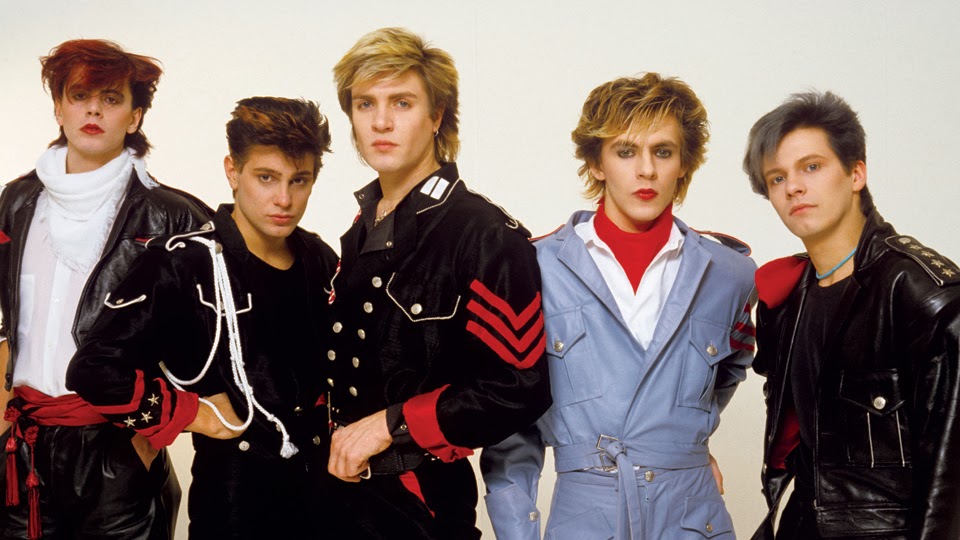
The lovely & talented Duran Duran, in the early 80's.
Fast forward to the mid-1980's. Technology had taken great leaps and a sharply digital edge began to dominate the production sounds of the Pop charts. The resurgence of Dance music was a cyclical dismissal of the simplistic lessons of late 70's Punk, and another enormous wave of British bands had overtaken the world's airwaves, record stores and televisions. Chief among these was Duran Duran, named after the villain from Roger Vadim's French science-fiction film, "Barbarella", Dr. Durand Durand. The band was easily one of the most successful of the 1980's, largely due to their heavy rotation in the MTV-driven video revolution. Since then, they have placed 14 singles in the Top 10 of the UK Singles Chart, and 21 in the Billboard Hot 100, achieving sales of over 100 million records.

The cover art for "Thank You".
In 1995, the band released their inevitable cover album, entitled "Thank You", which included their version of Lou Reed's "Perfect Day". In a video interview provided with the album's press kit, Reed himself said he considered Duran Duran's recording to be the best cover ever done of one of his songs. Whether Lou was sincere or just being kind and/or grateful, I don't know, but the Duransters certainly acquitted themselves well enough. At least on this track they did. Most album length cover projects should have been 5-7 song EP's, and this is one of those. Often, albums like this are simply too much of a good thing, which is far better than an overdose of one bad idea after another.

Here's Duran2 with Lou Reed's "Perfect Day". We hope you somehow manage to have one of your own.


Surprisingly, the entire album catalog of Duran Duran remains in print. This catalog includes several different attempts at a definitive collection, of which only one succeeds, and it is both worthy and capable of plugging the Duran-a-rama vacancy in your music library.

I'm certain there's been a bit of a run on albums from Lou Reed and The Velvet Underground as of late, but that is certainly not any indication or inference that those recordings are going out of print and are never to return. Quite the contrary. That is an urban myth the record companies want you to believe so the post-mortem buying frenzy will continue. You longtime Velvet fans probably have everything already, but for our newer or more casual listeners, I will recommend the so-called "banana album", or this excellent 2 disc anthology.

Lou Reed himself, however, is one of those rare performers whose work has not been well served by 'best-of' collections. So, while "Transformer" is a very good document of the glittery early 70's, as is the fabled live album, "Rock & Roll Animal", my recommendation for a definitive Lou Reed album is the gritty 1989 masterwork, "New York". In the opinion of many, Lou was never better than on this one, and I concur.

Saturday, October 26, 2013

Space Oddity / Ashes to Ashes / Major Tom (Coming Home)

A 1969 UK picture sleeve of the Philips single.
Today, I'm going to have to tell you one story just so I can tell you another. That's just how things unfold sometimes.

I've always found it interesting how certain fictional characters can take on a life of their own over the course of several unrelated works by different artists. Today's case in point is one Major Tom, who we first heard of in David Bowie's breakthrough song, "Space Oddity", from all the way back in 1969. For those unfamiliar with Bowie's narrative, Major Tom was an astronaut who, by accident or intent, has a malfunction with either his spacecraft or his tether during a spacewalk outside the ship, and is doomed to drift in space with no hope of returning to Earth. The song was very timely as the first moon landing occurred in July of 1969.


As for subsequent appearances, Bowie himself revisited the character in the song "Ashes To Ashes" from his 1980 album "Scary Monsters", but only in the form of a distant memory. Instead of an astronaut who casually slips the bonds of this world to journey beyond the stars, "Ashes..." describes Major Tom as a "junkie, strung out in heaven's high, hitting an all-time low". This lyric can be interpreted as a play on the title of Bowie's 1977 album "Low", which charted his own withdrawal inwards, following his cocaine excesses in America a short time before; a reversal of Major Tom's original withdrawal outwards towards space.


The final lines, "My mother said, to get things done, you'd better not mess with Major Tom", have been compared to the verse from a nursery rhyme, "My mother said, that I never should, play with the gypsies in the wood" Interviewed in 1980, Bowie described the song as "...very much a 1980's nursery rhyme". Years later, Bowie said that with "Ashes to Ashes", he was "wrapping up the seventies really, for myself, and that seemed a good enough epitaph for it".

Although Bowie would give another brief passing nod to the character in his 1995 song, "Hallo Spaceboy", the story of Major Tom had received more significant development back in 1983 from Peter Schilling in his international hit "Major Tom (Coming Home)", which was featured on his 1983 album, "Error In The System". Although the song was originally recorded in German as "Major Tom (Völlig Losgelöst)", translation: "totally disconnected", the hit version was sung in English. The song would remain Schilling's only visit to the upper reaches of the Pop charts, riding Bowie's coattails all the way to #14 on the American Hot 100.


Although that song has been recorded numerous times by the diverse likes of Plastic Bertrand, MXPX and Hilary Duff, the one that sticks is the version done recently by Shiny Toy Guns. Their synth-based sound and theatricality, along with a glittery stage production, really launches the song into the 21st century. I have to say I find it interesting that as up to date as Shiny Toy Guns sound, even a cursory listen to most of their songs shows an obvious lineage to the 80's band, Berlin. It wouldn't surprise me one bit if Shiny Toy Guns were to release a cover of "The Metro" sometime. While I'm not a fan of the blatant corporate sponsorship that is seen at the end of this video, I understand that a band's gotta do what they've gotta do if they want to play at the national level, even if that means doing a cover tune for a car commercial. For some, getting that commercial is the big break.


Pugwash
A lot of musical Bowie devotees have covered his songs, and it seems that many of them tend to specialize in darker genres like Goth, Emo, Techno and Electronica. Many of those covers are either too morose or soulless for me, although lyrically, Bowie hasn't been the most chipper chap when it comes to subject matter. But a good song always proves itself when it stands up well under a sparse acoustic treatment, such as this rendition of "Ashes To Ashes" by Irish pop wunderkinds, Pugwash, whose own original work is startlingly musical and refreshing. Here's Pugwash front man Thomas Walsh in a live performance with The Section Quartet.


And just when you think that this party has had all it can handle, in strolls William Shatner, of all people.

Shatner says in the liner notes to his 2011 album "Seeking Major Tom", that he and producer Adam Hamilton would often think "Is this absurd or is this awesome? Or is this absurdly awesome?". The basic premise was that Shatner had been presented, yet again, with the notion of recording some science-fiction related songs, which was of little interest to him, until he stumbled onto the character of Major Tom and wondered whether there was more of the good Major's story to be told. Shatner had apparently been long fascinated with the concept of the Major Tom character and his motivations. And so, Shatner and producer Hamilton went about vetting songs that might flesh out the tale of Major Tom, however speculative or vaguely referential they might be.

I'm just gonna say that every musical instinct in my being is telling me that I should loathe and despise this ham sandwich of an album. Like some other recent overblown concepts, this may have been successful as an EP of 5 to 7 songs. But as the concept quickly wears thin, 20 songs over 2 CD's is overkill, and ultimately buries the project under its own weight. But to be fair, sometimes performers do things that aren't intended to have much artistic merit. They do them because they're fun things to do. Like karaoke. Which is what this recording mostly is: Shatner-ized karaoke, and that has its own special charm, I suppose.

Which brings us full circle to William Shatner's renditions of both "Space Oddity" and "Major Tom (Coming Home)", the 1-2 punch that opens this album. I'm surprised that Shatner's producers didn't have him do "Ashes To Ashes" while they were at it. Guess they were too busy having him throw buckets of aural tempura on masterworks like "Bohemian Rhapsody" and yes, "Iron Man", which is worse than it sounds. Take it away, Shat-man.


If you are overcome with curiosity, or just want it because it's weird, you can find this wretched album, and other amusements by William Shatner at Amazon. Having said that, I will happily recommend his 2004 album, "Has Been", as it's overseen by Ben Folds and features musical guests like Joe Jackson and Henry Rollins, who bring a far better level of quality to the proceedings. It's everything "Seeking Major Tom" could have been. I understand that his latest musical exploration, "Ponder The Mystery", is a significant improvement, as Shatner is paired with more progressive musicians and new original music. I'll check it out when the mood permits. For all you Trekkies, Shatner's 1968 pop culture classic, "The Transformed Man", is back in print and a new copy can be yours for less than 3 bucks! It's kitschy, but worth it for the hilarious "Lucy In The Sky With Diamonds" medley.

As you might guess, music from Shiny Toy Guns and Peter Schilling is also available through Amazon. However, STG's version of "Major Tom" is currently available only as an Mp3 download single from Amazon. If all you want from Schilling is "Major Tom", then get thee to the excellent, 5 volume, 80's comp series, "Living In Oblivion" from EMI/Capitol, which contains many lost gems of the 80's, and can be obtained, used, for a mere pittance.

Music from the mighty Pugwash is available spottily only as pricey imports, as the band has no US label and only tours in Ireland, Scotland, Wales and the UK. For the curious, I will recommend their most recent effort, "The Olympus Sound", which is also likely the most affordable of their difficult to find catalog. Pugwash is working on their 6th album, due out next year.

And yes, there's more career-spanning music by David Bowie at Amazon than anyone would ever know what to do with. But do indulge. His 70's work is inarguably essential.

Saturday, September 07, 2013

Fame

"If it makes your neck muscles tighten, it's probably not funky. But if it makes your butt shake, then it might be." - Flea (Red Hot Chili Peppers)

David Bowie and James Brown, circa 2000. All is forgiven?
Although the primary focus of this blog is on cover versions, occasionally a song comes along that turns out to be a bit more than a cover. In this case, it's a blatant ripoff. But as Nick Lowe once said, "If you're going to pinch something, do it from a good source".

James Brown was often called “The Hardest Working Man in Show Business”. He was also, far and away, the most sampled and therefore, the most ripped off man in show business. Snippets of James Brown’s music have been sampled and used, often unlicensed, for many Top 40 hits and countless other tracks since the earliest beginnings of rap and hip-hop.

However, Brown, like others who were influenced by his music, did his own share of borrowing. His 1976 single "Hot (I Need To Be Loved, Loved, Loved)" used the very same distinctive main riff from "Fame" by David Bowie, and NOT the other way around, as is often believed. The riff was provided to "Fame" co-writers Bowie and John Lennon by Bowie's guitarist Carlos Alomar, who had briefly been a member of Brown's band in the late 60's. This happened late in the sessions for Bowie's 1975 album, "Young Americans". The album sessions in Philadelphia were cut short in favor of moving the operation to New York, so Bowie and Lennon could work together. Two songs from that collaboration ended up on "Young Americans"; significant for a record with only 8 songs on it.

My own online research on recording and release dates for both "Fame" and "Hot..." appears to confirm this, so it seems that James was not above some creative appropriation himself. Perhaps it was a way for James to get back at Carlos Alomar for some undisclosed disagreement. Maybe James just dug the riff enough to swipe it, even though he about made off with the whole song. Despite Brown's rewriting of the entire lyric, I think you'll find that the hook, the chord changes, and the rhythm breaks are the same. Only those involved know for sure. I can't find any record of any legal proceedings regarding this matter, and so I must assume that all parties decided to leave it be.

You be the judge. Here’s David Bowie with "Fame" from the "Young Americans" album. John Lennon's vocals can be clearly heard throughout the song.


Now, here's James Brown's "Hot...". The lyric is different, but that hook is in full effect! This song was released as a single in December of 1975, reaching #31 on the Billboard R&B chart, and later appeared as the lead track on Brown's 1976 album, "Hot".


Whatever you decide, both recordings belong in your music library. Most of the David Bowie catalog is still in print; often featuring nicely upgraded mastering and packaging. However, sorting through all the funky greatness by James Brown that's available is a formidable task; one best left to the serious collector. As a reasonable alternative, I will highly recommend that, without hesitation, you avail your bad self of the box set, "Star Time", which can be had, used, for under 20 bucks. It contains all the hits, big and small, along with all of the essential album cuts; a 'must' for any respectable collection.

Saturday, May 18, 2013

All The Young Dudes

For Mott The Hoople, it really was all about the shoes.
Mott The Hoople's recording of the David Bowie song, "All The Young Dudes" usually pops up on most any decent compilation of '70's rock. The song has a distinct tie to the early part of the decade, when British Glam ran amok through the high schools of America, despite the best attempts at taming kids with the likes of The Carpenters, The Captain & Tennille, America and ironically, Elton John, along with some of the other more saccharine pop idol singles that dominated radio airplay. In retrospect, Glam was just the warmup for the Punk explosion in '77. Even though the band members of Mott were all straight, this song became a gay anthem, at least in America, thanks to lyrics like "Lucy looks sweet 'cause he dresses like a queen".

Mott had very nearly packed it in by 1971 after releasing 4 albums, yet still had a cult following in England and Bowie was a big fan. Bowie heard about their impending breakup when Mott bass player Pete 'Overend' Watts called him up, looking for work. In an effort to keep the band together, he offered to produce their next album and provide them with a song he was working on. Since they had alienated their record label, Island, Bowie got them some time at Olympic Studios in London in the middle of the night. Besides producing the track, Bowie played some guitar, did handclaps and sang backup.


Yep, it was one of those 'game changer' albums.
When Bowie first offered the song to Mott The Hoople, they recognized its potential straight away.  Mott didn't know this when they recorded it, but Bowie had intended it for his own album, "The Rise and Fall of Ziggy Stardust and the Spiders From Mars". Good thing they accepted it, since Mott had already rejected Bowie’s “Suffragette City”, which would become an essential track on "Ziggy Stardust".

The lyric line, "All the young dudes carry the news" refers to part of Bowie's story where there is no electricity, and Ziggy Stardust uses songs to spread the news. Said Bowie: "'All the Young Dudes' is a song about this news. It's not a hymn to the youth, as people thought. It is completely the opposite".

David Bowie and Mick Ronson, 1972
Another lyric, "Wendy's stealing clothes from unlocked cars" was originally sung as "Wendy's stealing clothes from Marks and Sparks", which was the popular nickname for the British department store Marks & Spencer. The BBC refused to play a song if they thought it contained lyrics advertising a product. In their hit, "Lola", The Kinks had to change "Just like Coca-Cola" to "Just like cherry cola" at the last minute, so Mott had to get rid of Marks and Sparks. At the insistence of their record company, Ian Hunter flew from New York to London to re-record the line as "unlocked cars" before heading right back to America. Such is how things were done before we had transatlantic fiber optic data lines.

After the first recording session for this song, Bowie reportedly thought it was lagging at the end (which may provide a clue as to why he donated the song). Mott's lead singer Ian Hunter responded with the idea for the one-way conversation, which begins with him saying, "Hey, you down there, you with the glasses!" Said Hunter: "I remembered an encounter I'd had with a heckler during a recent gig at the Rainbow in London. He was annoying me and I ended up pouring beer all over him."

The song became the title track for what became Mott's breakthrough album for their new record company, Columbia. They followed up with "Mott" in 1973, and of course, "The Hoople" the following year.

Because I'm sure some of you are curious, the band's name came from the 1966 Willard Manus novel, "Mott the Hoople", about an eccentric who works in a circus freak show. According to a 1966 review of the novel, "Hooples, to clear this up right at the beginning, 'make the whole game possible, Christmas Clubs especially, politics, advertising agencies, pay toilets, even popes and mystery novels.' Obviously they're squares and Mott, Norman Mott, is certainly not." Sounds like band name fodder to me!

Despite having donated such a great song, Bowie had several bullets in reserve for the Ziggy project, so it wasn't any sort of great loss. Some of the songs besides "Dudes" that didn't make the final running order for one reason or another include "John, I'm Only Dancing" and "Velvet Goldmine", both released later as single b-sides and "Man In The Middle", which has never been officially released. But Bowie had also recorded his own take on "All The Young Dudes" during the sessions for Ziggy. Once Mott had a hit with it, Bowie shelved his version of the song, which sat unreleased until EMI put out a Bowie compilation in 1995. I'd only heard this recording once prior to the 90's, on a late 70's radio broadcast of rare Bowie stuff. The mix was very rough and distorted, like most bootlegs. It sure is great to have it available properly mixed and mastered.

Here's David Bowie and The Spiders From Mars doing "All The Young Dudes". While this is playing, I'd like for you to listen to the extraordinary lead guitar work of the late Mick Ronson. His guitar tone had a very distinct voicing and tone. While his equipment setup was simple, Ronson had a unique way of getting his massive, squalling sound.


Ian Hunter and Mick Ronson, on stage in 1975.
I caught this tour in Philly. Opener was Aerosmith!
Throughout the Ziggy era, Ronson played a '68 Gibson Les Paul Custom; a 'Black Beauty' stripped to the natural wood finish, through a Marshall Major head, a model that had evolved from the Marshall 200 of late 1967; an amp introduced to satisfy the arena-rock players of the day who weren't getting enough volume from the 100-watt Marshall JMP100 models. This 200-watt Marshall employed four large KT88 output tubes to belt out unholy volume levels, and it had to be fit into a widened cabinet, which Ronson nicknamed “The Pig” for its stout dimensions.

On the floor, Ronson employed a Vox wah-wah pedal, which he occasionally left at set positions to act as a tone filter to notch his midrange sound and an Echoplex; a primitive delay/repeat device that used a loop of recording tape in a cartridge, which often malfunctioned. He also used a Vox Tone Bender pedal on occasions when fuzz was required more than pure tube amp overdrive.

Ronson also recorded with Ian Hunter and Mott The Hoople, "Transformer" era Lou Reed, with whom he also arranged and produced many songs, and John Mellencamp, whose hit “Jack & Diane” he co-wrote and played the power chord intro on. Unfortunately, Ronson's solo career was one of fits and starts. Mick Ronson died in April 1993, of inoperable liver cancer. For all things Ronno, please visit mickronson.com.

All of the original albums by Mott The Hoople, along with several decent anthologies, are available at Amazon. David Bowie's extensive catalog has gotten a bit confusing over the years, having been through multiple record labels and re-masterings. Not all of them were improvements. EMI seems to have finally gotten the Ziggy Stardust album sounding right, without your having to pop for the overpriced 40th anniversary edition. CD's containing Bowie's version of "All The Young Dudes" can be found here, here, and if you're feeling extravagant, here.