Showing posts with label Elton John. Show all posts

Saturday, November 22, 2014

Review: Goodbye Yellow Brick Road - Deluxe Edition

Seeing as how this 2 disc deluxe edition was released this past March, I have to acknowledge that I'm a little late to the party with this review. The truth is, I've been avoiding it. But now, several months later, I've given it plenty of opportunity to justify its existence, and I'm still having trouble understanding why this edition was released at all if it was going to be so poorly thought out. I did wonder if Elton John personally approved this release or not, but according to the booklet notes, he did.

In the booklet, we are also reminded of the unique paradox that Elton John presented. Here was a gay man from an unglamourous suburb of North London, writing and performing songs in a rustic style that would later be referred to as Americana, while dressed in a manner that Liberace might have called excessive. His sartorial choices were not reserved for the stage either, but Elton was not about to be outdone by any Glam rockers of the day. By 1973, Elton John was one of the biggest Rock stars on the planet, and nearing the top of his game, both as a songwriter and as a live entertainer. He could seemingly do no wrong, no matter how flamboyant his recordings and live shows became. (Inevitably, that came later on.)

I should clarify that the problem I have with this release is not with the album itself. "Goodbye Yellow Brick Road" is an unimpeachable cornerstone album of 70's Rock, and is certainly one of Elton John's career highlights. It spent 8 weeks at #1 and sold 7 million copies in the U.S. alone; huge numbers for a double LP. It's one of those records that every high school age kid had, to the point where siblings in the same household each had their own copy. So, I just want to make clear that I feel the album is, and always was, great. It's the bonus tracks I have a problem with.

The spendier Super Deluxe Edition
In a peculiar packaging move for this 2 disc edition, Mercury/Universal has gone off script and chosen not to include the expected parade of bonus tracks, which normally consists of demos, outtakes, B-sides from singles, non-LP singles, etc. No, this time we get a curious series of 9 cover versions of songs from the album that are performed by contemporary musicians, along with another 9 tracks which have been edited from the full-length 1973 Hammersmith Odeon concert, which is on the Super Deluxe edition. This much pricier package contains 4 CD's, a DVD, and a hardcover book. 2 of the CD's contain the complete 18 song concert, along with 10 tracks of the aforementioned B-sides, demos, and other bonus material.

I hate to say it, given the concept of this blog, but for the 2 disc set, I would have much preferred that the cover versions had been included only on the bigger box, the edited live tracks ditched altogether, and replaced with the expected set of outtakes. Here's why. The 9 covers, as a group, are not solid enough to support a stand-alone release, and have the effect, along with the gratuitous, hits-leaning selection of the live stuff, of coming off as little more than filler. This supports some of the recent theorizing I've heard regarding diminishing returns with bonus tracks.

But since we're stuck with them, we'll move on. I've always said that a good cover recording has respect for the original song, yet manages to sound like the artist doing the cover could have written it. Unfortunately, what we have a lot of here is the victory of style over substance. My cynical side wonders if hosting the cover versions on the album legitimizes a double, or possibly, considering the live tracks, a triple dip of publishing royalties for Elton and Bernie Taupin. At any rate, let's dig in and tackle the covers in sequence.

Ed Sheeran
The first track, "Candle In The Wind", is given a lilting acoustic treatment by Ed Sheeran that is enjoyable enough, but provides no direct sign that it's Sheeran. It could be anyone you might find on Sirius XM's Coffee House channel. But Sheeran's track sounds like a gift in comparison to the digital hammering that "Bennie And The Jets" receives at the hands of someone named Miguel and his rap-happy accomplice, Wale. I've never been overly fond of "Bennie", but in no way did it deserve this gut-wrenching treatment. Elton John is a vocal advocate of being proficient at playing live, and this cut is nothing but soulless studio gimmickry. If I were Elton, I would have demanded that it be removed from the album.

Next up is a calmer, faux-country treatment of the title song, "Goodbye Yellow Brick Road", by Nashville wunderkind, Hunter Hayes. The production is as slick as anything Nashville would be expected to put out these days, and Hayes would sound right at home on "The Voice" or "American Idol". Like Sheeran's track, it's as generic and safe as plain label corn flakes, and just as nutritionally empty.

The Band Perry
But then, we hit on a surprising bit of originality in an unexpected place. The Band Perry, owner of one of the clumsiest names for a successful group in memory, strikes gold with their fine rendition of "Grey Seal"; a deep album cut that was first recorded by Elton during his earliest sessions, and was resurrected for the "Yellow Brick Road" album. Despite the tight production, The Band Perry has great fun with the song, filling it with the requisite fiddles and banjo rolls that don't get in the way of the vocal harmonies. They finish out the track with a brief, but jammy fiddle lead that fits the original outro perfectly. Most importantly, it sounds like them. I don't know whether to give props to the band or their producers, but if they can pull this tune off live, and sound this good, then I salute them. Give it a listen.


Emeli Sande
After all that excitement, someone must have thought we needed a nap. So now we have the droll baritone of John Grant and his Smith Brothers beard, crooning their way through "Sweet Painted Lady". I've always liked the song, but the spare, droning synth-string backing feels cold, so when combined with Grant's warm voice, we get what another reviewer referred to as "chalk and cheese"; a serving of an overall, less than palatable hors d'oeuvre.

This brings us to Emeli Sande, and her rendition of "All The Girls Love Alice". The song is hampered by the same production tricks as most contemporary Pop recordings are, with the notable exception that there is some genuine soul in Sande's vocal. This comes as welcome relief after the previous song, yet production similarities remain. Sande hasn't quite broken through in the states yet, but just may with her single, "Next To Me". All she needs is a good song on a movie soundtrack album.

Imelda May
The next 2 tracks are some of Elton's best known Rock 'n Roll shouters. Irish rockabilly firecracker Imelda May yanks us onto the dance floor with her energetic performance of "Your Sister Can't Twist (But She Can Rock 'n Roll)". Imelda has one foot in the past and the other in the future. Her band does an excellent arrangement of this song that swings as much as it rocks, and with total conviction. This track is just terrific, so crank it up!


Unfortunately, the swing does not hold for Fall Out Boy's noisy, arrhythmic attempt at "Saturday Night's Alright For Fighting". The track has plenty of Rock, but precious little Roll. If they'd approached the song by remembering that it was inspired by Bernie Taupin's observing a parking lot altercation near a pub, then they may have come away with something more effective. As it stands, they're mere steps away from "S-A-TUR-DAY... NIGHT!" The song would have been in far better hands being rendered by a Punk band with old school sensibilities, like Rancid or Dropkick Murphys.

The Zac Brown Band
Closing out the disc, as it was on the original album, we have an earnest rendition of "Harmony" by The Zac Brown Band. Focusing on the vocals and avoiding unnecessary production sweetening, the ZBB acquit themselves well with a performance that is faithful to Elton's original, while sounding different enough to make it theirs. I'll bet they could pull this off live with little difficulty.


I've also noticed that Zac Brown and his cohorts have involved themselves in a few different collaborative musical projects, while managing to not antagonize their core audience, who got hooked on their down-home, Jimmy Buffett meets Southern Rock identity. That's no easy task these days, and done at no small risk either. But that musical curiosity, and a willingness to experiment leads me to predict a long-haul career for Zac Brown, whether he keeps the original band together or not.

In conclusion, I'll reiterate that including these cover versions on this latest reissue of "Goodbye Yellow Brick Road" has the effect of reducing even the good songs to being mere filler. It's a disservice to both the original album, and to the few cover recordings that are worthwhile. I feel it's also no small insult to the consumer, who's being coerced into forking out for yet another 'definitive' remaster. All of the cover songs would fare better being included on releases by their individual performers. And yes, we'd much rather have demos, B-sides, and other 'cutting room floor' items than this lot.

The value of the live recordings depends entirely on your enthusiasm for them. If you want them at all, then you may just want to pop for the Super Deluxe edition, so you'll have the entire concert, along with all the other goodies included in that set. According to Amazon, a perfectly suitable 40th Anniversary single disc version of GYBR is available, and very affordably so. But if you're so inclined, go for the 2 disc set, though if you've read this far, you've been suitably warned.

I would encourage those of you with high end Surround systems to pick up the HD Pure Audio Blu-Ray edition, as 2 readers have already told me about the superior listening experience it provides. Those with turntables should consider the excellent 180 gram vinyl reissue, which should take you right back to 1973. With that in mind, a revisiting of Elton's early 70's work is always welcome, and recommended.

Saturday, January 25, 2014

Lucy In The Sky With Diamonds

"We hope you have enjoyed the show." Indeed, we have.
If you've read any of the better biographies of The Beatles, you'll find that the flow of their creative waters were not moved by just their own internal thoughts. As writers, they often picked up on external inspirations rather easily and were able to expand lyrically on the simplest of stimulae. For example, their landmark 1967 album, "Sgt. Pepper's Lonely Hearts Club Band" contained two key songs that were directly inspired by works of art. One was the 1843 circus poster that John Lennon had obtained in an art gallery that contains the lyrical script of "Being For The Benefit Of Mr. Kite" nearly verbatim. The other was "Lucy In The Sky With Diamonds", which came from a drawing done at pre-school by Lennon's young son, Julian.

Relax and give a listen to The Beatles' "Lucy In The Sky With Diamonds" in case it's been a while.


Julian Lennon's drawing of Lucy in the sky. With diamonds, of course.
Far from being Lennon's overt paean of admiration for the virtues of the psychedelic drug LSD, (to which Lennon was admittedly no stranger by then), the idea for the song presented itself in a sketch by 4 year old Julian Lennon, depicting his classmate, Lucy O'Donnell, floating in the sky with diamonds as stars. In a 2009 interview, Julian Lennon said, "I don't know why I called it that or why it stood out from all my other drawings, but I obviously had an affection for Lucy at that age. I used to show Dad everything I'd built or painted at school, and this one sparked off the idea."

Although Paul McCartney did have some lyrical input on the song, he acted mostly as a sounding board for Lennon on this one, who said this about the song's alleged drug glorification in 1980. "I had no idea it spelt LSD. This is the truth; my son came home with a drawing and showed me this strange looking woman flying around. I said, 'What is it?' and he said, 'It's Lucy in the sky with diamonds', and I thought, 'That's beautiful', and I immediately wrote a song about it. It was purely unconscious that it came out to be LSD. Until somebody pointed it out, I never even thought of it. I mean, who would ever bother to look at the initials of a title?"

The real Lucy O'Donnell-Vodden, as a pre-schooler and in her early 40's.
But Lennon also revealed that many of the song's trippy images were adapted from Lewis Carroll's book "Alice In Wonderland". "It was Alice in the boat. She is buying an egg and it turns into Humpty Dumpty. The woman serving in the shop turns into a sheep, and the next minute they are rowing in a boat somewhere and I was visualizing that. There was also the image of the female who would someday come save me; a 'girl with kaleidoscope eyes' who would come out of the sky. It turned out to be Yoko, though I hadn't met Yoko yet. So maybe it should be 'Yoko In The Sky With Diamonds'. But she was my imaginary girl that we all have."

And as for the real Lucy of the title? Julian's classmate Lucy O'Donnell didn't know she had been immortalized in a Beatles song until 1976, when she was 13. Sadly, Lucy O'Donnell-Vodden passed away from complications of Lupus in September of 2009 at age 46. Earlier that year, Julian had released an EP, "Lucy", when he found out that his childhood friend was suffering from Lupus. All the proceeds from the EP benefited the Lupus Foundation in the United States and UK. Julian then revealed that the original drawing had been lost, but was later discovered to have been bought at auction by David Gilmour of Pink Floyd. Gilmour permitted the drawing to be reproduced for the EP sleeve, but retains ownership of the original to this day.

Partake at your own risk.
Even by the mid-1970's, the heartbreak of The Beatles being no more was still a relatively fresh wound on the musical heart of the public, but the love for their music continued unabated. Each of The Fabs had racked up solo successes by then, and some of that would be arguably the best music of their careers. Assorted soundtrack recordings and tribute covers of varying degrees of quality were selling well, including the numerous and numbingly bad cover versions of Beatle songs by TV personalities; best represented by William Shatner's notoriously hammy take of "Lucy In The Sky..." that can be cordially described as... unique.

When Elton met John, and vice versa.
It was in this Beatle-receptive environment that Elton John released his cover recording of "Lucy In The Sky With Diamonds" as a stand-alone single in November of 1974. Recorded at the Caribou Ranch In Colorado around the time of other sessions that resulted in Elton's 1975 hit album, "Captain Fantastic and the Brown Dirt Cowboy", the single featured backing vocals and guitar by John Lennon under the pseudonym of Dr. Winston O'Boogie. The single topped the US Billboard pop charts for two weeks in January of 1975.

There's not much info I can find regarding how or where the two met, but it happened during Lennon's infamous "Lost Weekend" period earlier in 1974 when he was separated from Yoko Ono and getting around quite a bit, but generally adrift and behaving badly. Their meeting resulted in Lennon appearing on Elton's cover of "Lucy...", and the intended b-side for the single, which was Lennon's song, "One Day At A Time." In return, Elton was featured on "Whatever Gets You Thru The Night", which appeared on Lennon's "Walls And Bridges" album. Later that year, on Thanksgiving Day, in what would be Lennon's last major live performance, the pair performed these two #1 hits along with the Beatles classic "I Saw Her Standing There" at Madison Square Garden in New York. Lennon made the rare stage appearance with Elton and his band to keep his end of a wager Elton had made with him that Lennon would appear on stage with Elton if "Whatever Gets You Thru The Night" became a #1 single. It was also that same evening that Yoko and John were reunited; for good this time.

Here is the Elton/Lennon version of "Lucy In The Sky With Diamonds"; a remarkable recording in that it features the author participating in a thorough reinvention, which completely respects the original song while sounding like absolutely no one except the artist doing the cover. Enjoy!


The Hooters
It's one thing for musicians who are fans to perform straight covers of their favorite songs, and that's the most common approach. It's quite another to attempt another reinvention; especially when it was previously done so well and with considerable success. That takes a brave band with a unique sound.

The ride taken by The Hooters from the suburban bars of Philadelphia to the big stages of the world went into overdrive starting in 1983 with the release of a self-produced, 8 song EP which sold over 100,000 copies. The success of their first 2 releases for Columbia, "Nervous Night" and "One Way Home" in 1985 and '87 respectively, led to appearances opening Philadelphia's Live Aid concert in 1985, and later, a featured spot at the Amnesty International concert alongside the likes of U2, The Police, Bryan Adams, Lou Reed and Peter Gabriel. The band is also remembered for co-writing "Time After Time" with Cyndi Lauper; a fine song to be remembered for, indeed.

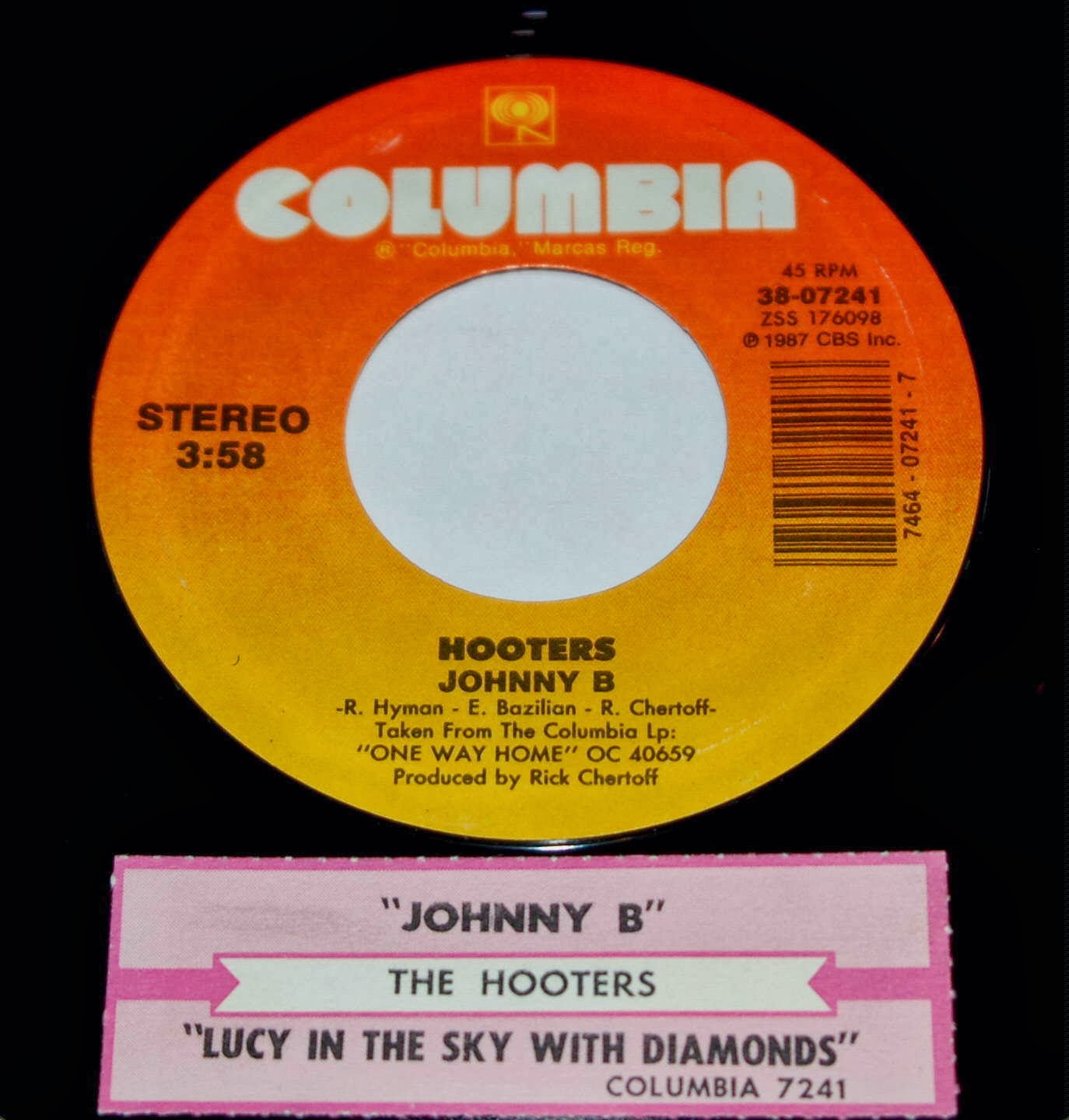
During their peak years, they played a series of shows at Philadelphia's legendary Tower Theater, recording and filming the proceedings. During the Tower shows, The Hooters unveiled a new arrangement of "Lucy In The Sky With Diamonds" that served as a break in the set, and a vocal spotlight for bassist Andy King. Such was the regional popularity of The Hooters at the time, they could have busted out a Hooterized rendition of "Turkey In The Straw" and the fans would have lost their minds, but "Lucy..." was a fine choice for a band that was already known for making clever choices for their infrequent cover songs. Parts of the live concert footage saw release on VHS, but "Lucy..." only got a limited release as the b-side to the single, "Johnny B". It's great how they build tension in the arrangement by saving the release of the chorus for the very end of the song, and by stripping things down to dual mandolins, a keyboard pad, and vocals. Enjoy!


The Hooters' version of "Lucy..." can be found on this anthology, which is the best of a few collections of their work out there. The original EP, "Amore", is a fantastic ball of 80's energy that has become one of the cornerstones of Philly Rock. Their 3 Columbia albums are all still available for a most agreeable price. The band is still active and tours Europe regularly. Check out their website for current info.

There is more music available from Elton John than anyone would ever know what to do with. From what I can see, nearly everything he's ever recorded is in print in some form or another at varying price points. Choose as you will. "Lucy..." can be found on most editions of Elton's "Captain Fantastic" album.

This leads us back to The Beatles, as does most things. Our featured song, "Lucy...", is available on their essential "Sgt. Pepper" album. But honestly, all of their albums are essential, aren't they? So if you haven't already done so, or have been putting it off, just dig deep and pop for the box and be done with it. A splendid time is guaranteed for all.

Saturday, June 22, 2013

My Baby Loves Lovin'

Elton John, flamboyant even then.
Every musician, no matter how famous they may become, has humble beginnings. Most never escape them, slogging away for decades in taverns and other venues of varying quality around the world. If they're lucky, connected and very good at what they do, they'll get the chance to play on a recording as hired help. Some musicians have made their career of exactly this; forsaking the charms of fame, which most studio players consider overrated anyway. There are hundreds of skilled players who've done plenty of studio work prior to their own name becoming better known by the public. Leon Russell and Glen Campbell are two that you may know. But then, there's the case of one Reggie Dwight, whom you know as Sir Elton John.

As late as 1970, Elton helped pay the rent and gain studio expertise as a session vocalist and piano player by doing sessions for British budget records that "re-created" the sound of current hit singles; a precursor to the legendary K-Tel collections in America, which typically presented 20 truncated versions of current pop singles, but at least those were done by the original artists. In these copycat recordings, Elton took on such vintage AM pop mothballs as Mungo Jerry's "In the Summertime", "Up Around the Bend" by CCR, Badfinger's "Come & Get It", "Yellow River" by Christie and oddly, Nina Simone's classic, "To Be Young, Gifted and Black", along with a few stray songs that were hits only in the UK.

Tony Burrows
Of important note is that Elton was most often employed by varying assemblies of the songwriting and producing trio of Tony Macaulay, Roger Cook and Roger Greenaway. By 1970, Elton had anonymously lent his vocal and keyboard talents to several collections of faux hits. This production group also periodically employed a popular session vocalist named Tony Burrows, who had the distinction of performing the lead vocal on no less than 5 legitimate worldwide hit records by otherwise fictional bands, such as Brotherhood of Man ('United We Stand'), First Class ('Beach Baby') and Edison Lighthouse ('Love Grows Where My Rosemary Goes'). These groups existed in name only. Session musicians would appear as the group for TV appearances. We'll have more on Mr. Burrows in a bit.

Elton John's contributions to these albums have been assembled in a CD release intended for budget bins. There are at least 4 different packagings of this music that I've seen. The album cover shown here is the most common and most representative of what the original cheap-o record albums looked like. This reissue, complete with scholarly liner notes, aspires to do nothing more than preserve this footnote in the budding superstar's career, and is of interest mostly to completists and novelty seekers like myself. At the time they were made, Elton, like any other employee, was paid his fee for doing the recording and that was that, so I am certain that Elton holds no rights whatsoever to these recordings or he likely would have squashed the release of this compilation.

These records were never intended to be taken seriously as artistic statements. They were made to squeeze a few quick pounds from casual, unsuspecting pop fans. Musically, for his part, Elton plays it straight; his vocal chops proved to have the necessary versatility and anonymity required of such projects. But, as far as unintentionally funny moments go, there are many. So much so, that it was difficult to pick just one song to feature.

Out of all the tracks on the album, the one that gives the best flavor of the time and what these knockoff records were about is the remake of "My Baby Loves Lovin'", a 1970 hit for the group, White Plains. I think you'll find that Elton's vocal on this track is unmistakably him. Enjoy!


The 1970 UK single picture sleeve.
The original version of the song was written by the afore mentioned Roger Cook and Roger Greenaway. It was recorded on 26 October 1969, and released on 9 January 1970 on the Decca imprint, Deram Records. A fellow you may have heard of named Tony Burrows performed the lead vocal for the single by the nonexistent White Plains, as was becoming his vocational habit. Why the production team thought it was necessary to re-cut a song that they already owned makes little sense, unless the motivation was either publishing money or solely to keep in line with the other retreads on those knockoff albums.

At any rate, here is the Tony Burrows-led faux band, White Plains with "My Baby Loves Lovin'". I think you'll agree it's a pop song very much of its time, but it does have an exuberance that is rarely heard today. Enjoy!


So where can one find the Elton John recordings? Well, there's 3 versions listed at Amazon. If you are so prone, you might score one of the Laserlight editions by digging in the bargain bins at your local big box store, as that was their intended destination anyway. The White Plains single is nicely remastered on the exponentially great series from Rhino Records, "Super Hits of the '70s: Have a Nice Day"; a set of at least 25 CD's released back in the early 90's. There was a box set that had the entire series in it, but that is now very rare and very spendy. It's much cheaper to cherry pick used copies individually.